
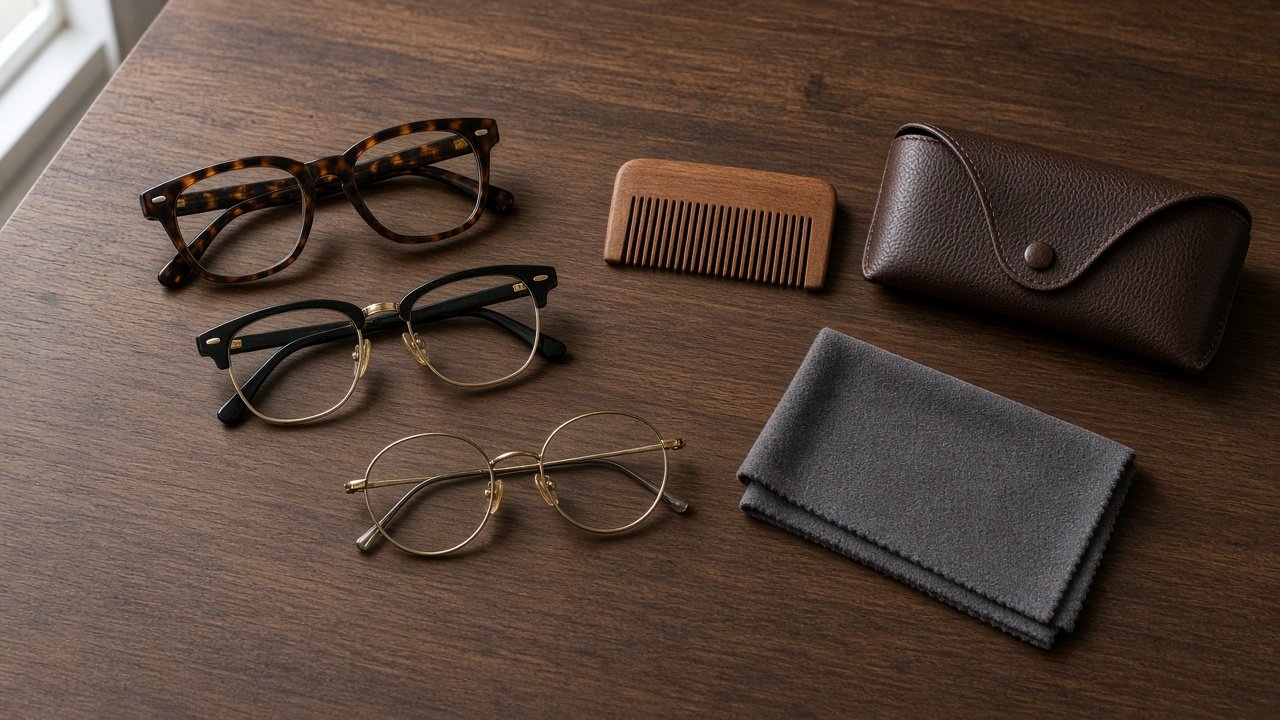
Glasses and beards have a lot in common. Both sit right in the middle of your face, both change how wide or long your face looks, and both are hard to ignore. Get the combination right and they work together like a well-cut jacket and good shoes. Get it wrong and one fights the other: a heavy beard can swallow tiny frames, and loud frames can make a neat beard look like an afterthought.
This guide covers glasses and beards together: how to work out your face shape, which frames suit which face and beard style, how glasses should physically fit on a bearded face, and a few real frames worth trying.
Key takeaways
- Start with your face shape, then factor in the beard. A beard changes your jawline, so judge your face shape with the beard you actually wear.
- Contrast is the basic rule. Round faces suit angular frames; square faces suit rounder or thinner frames, as GQ’s face-shape guide explains.
- Match frame weight to beard weight. A full beard can carry thicker acetate or browline frames. A light stubble look suits thinner frames.
- Fit beats fashion. Frames should sit centred, with lenses centred on your pupils and a width close to your face at the temples, according to All About Vision.
- Try before you commit. Warby Parker’s site, for example, offers virtual try-on and Home Try-On.
Why Glasses and Beards Need to Be Chosen Together
A beard adds visual weight to the lower half of the face. Glasses add weight to the middle and upper part. Together, they decide where people’s eyes land and how your face’s proportions read.
That’s why advice written for clean-shaven faces doesn’t always work. A full, boxed beard can turn a round face into something closer to a square. A long, pointed beard makes a face look longer. Your frames need to balance the face you have with your beard, not the one you had before you grew it.
Step 1: Find Your Face Shape (Beard Included)
GQ’s guide to hair, beard and glasses by face shape suggests a quick self-measurement. Use a soft tape measure or a mirror and compare four things:
- Face length: from the hairline to the bottom of the chin.
- Forehead width: across the widest part of the forehead.
- Cheekbone width: across the widest part of the cheekbones.
- Jaw width: along the jawline.
Compare the numbers and you’ll usually land on one of these shapes:
- Oval: longer than it is wide, with balanced, softly curved features.
- Round: length and width are similar, with soft cheeks and jaw.
- Square: a strong, angular jaw, with forehead, cheekbones and jaw at similar widths.
- Rectangular (oblong): clearly longer than it is wide, with fairly straight sides.
- Diamond: the cheekbones are the widest point, with a narrower forehead and chin.
Original article: GQ – The right hair, beard and glasses styles for your face shape
Step 2: Match Frames to Face Shape and Beard Style
Here is how GQ pairs beard styles and glasses for each face shape, with a few practical notes added.
| Face shape | Beard goal | Frames that usually work |
|---|---|---|
| Oval | Keep the natural oval shape | Almost any frame, as long as it’s in proportion |
| Round | Short sides, more length at the chin | Sharper, rectangular frames that sit slightly wider than the cheekbones |
| Square | Shorter sides, longer chin | Thin, round frames to soften the jaw |
| Rectangular | Fuller on the sides, short at the chin | Round, thin frames; a “professor” look |
| Diamond | Fill in under the jaw | Wider, angled frames that balance the cheekbones |
Round face with a beard
If your face is round, your beard and your glasses can do the same job: add structure. Keep the sides of the beard short and let the chin grow a bit longer to lengthen the face. Then pick rectangular or angular frames. Frames that extend a little past the cheekbones help the face look narrower.
Square face with a beard
A square face already has strong angles, so piling on more right angles can look harsh. GQ suggests thin, round frames here. Keep the beard shorter on the sides and a little longer at the chin, so the jaw looks less boxy.
Rectangular (long) face with a beard
A long face needs width, not more length. Grow the beard fuller on the sides and keep the chin shorter. Choose round frames with a thin rim to break up the vertical lines. A deep, oversized frame can also help, because it covers more of the face’s height.
Oval face with a beard
Lucky you: almost any frame works. Keep the beard following the natural oval of your face, and choose frames mostly on taste and fit. The main thing to avoid is extremes, such as tiny frames on a big face or oversized frames on a small one.
Diamond face with a beard
With wide cheekbones and a narrower chin, the goal is to add width at the jaw and above the eyes. GQ suggests filling in the beard under the jaw and wearing wider, angled frames.
Step 3: Match Frame Weight to Beard Weight
Face shape is only half the story. The other half is how much beard you have. As a rule of thumb from style guides and forum advice:
- Heavy stubble or a short boxed beard: Mid-weight frames in acetate or metal work well. You have room to experiment.
- Full beard: Thicker acetate frames, bold tortoiseshell or browline frames balance the extra weight at the bottom of the face. Thin wire frames can look lost.
- Long beard: Here, lighter frames often look better. A long beard already makes the lower face heavy; huge frames on top can make the whole face look crowded. Thin metal, semi-rimless or a slim browline is a good middle ground.
- Moustache-forward looks: If you wear a big moustache, check that the bottom of the frame doesn’t sit too close to it. A little gap keeps the face from looking cramped.
Advice on Reddit’s r/malefashionadvice points the same way: thick full-rim frames, especially dark or tortoise acetate, add definition, while rounder frames soften a square or angular face.
Original article: Reddit r/malefashionadvice – A guide to glasses
Why browline frames are popular with bearded men
Browline frames have a thick top bar, often in acetate, with thinner metal around the lower half of the lens. The heavy top line strengthens the brow area, which balances a strong beard below it. The thin lower half keeps the frame from adding more weight at the cheeks, where the beard already starts.
How Glasses Should Fit on a Bearded Face
Style only works if the frames fit. All About Vision, a consumer eye-health site, sums up the basics:
- Centred on your face, with the lenses centred on your pupils.
- Frame width roughly matching your face width at the temples. Not wider, not narrower.
- The bridge resting comfortably on your nose, without pinching, leaving marks or slipping. Nose pads can be adjusted.
- Temple arms that follow the side of your head and rest gently behind your ears without digging in.
The three numbers on the inside of most frames help you compare sizes: lens width (usually 40–60 mm), bridge width (usually 14–24 mm) and temple length (usually 120–150 mm). An optician or optometrist can measure your pupillary distance and adjust the frame, which matters most for strong prescriptions and progressive lenses.
Original article: All About Vision – How should glasses fit?
Beard-specific fit tips
A few extra things to check when you have facial hair:
- The cheek test. Smile broadly. If the bottom of the frame lifts off your nose or rubs your cheeks, the frame is too deep or sits too low.
- Sideburns and temple arms. Thick sideburns can push the temple arms outward and make frames sit crooked. A tidy trim above the ears helps them sit straight.
- Keep the beard line clean. A sharp cheek line and a neat neckline make frames look more deliberate. A beard that creeps high up the cheeks can crowd the bottom of the lenses.
- Beard oil and lenses. Wash your hands after applying beard oil, and before cleaning or adjusting your glasses. Oily fingertips are a common cause of smudged lenses.
- Mask or scarf season. In cold weather, a scarf pulled up over a beard can fog the lenses. Tuck it just below the beard instead.
Colours That Work with Beards
Colour matters as much as shape:
- Dark brown or black beards: Tortoiseshell, black and dark green frames all look natural. Black frames create the strongest contrast.
- Red or ginger beards: Warm tortoiseshell, honey and amber tones often look good. Very bright red frames can clash.
- Grey or salt-and-pepper beards: Silver, gunmetal, clear grey or navy frames suit cooler tones. A bold black frame can add sharp contrast.
- Blond or light beards: Lighter tortoiseshell, clear or thin metal frames keep the look from becoming too heavy.
Glasses for Men with Beards: Frames to Try
Prices were taken from the brand product pages at the time of writing. Warby Parker lists “starting at” prices, and lens options can change the final cost. Moscot’s price is for its optical frame listing.
1. Warby Parker Wilkie (Black Matte Eclipse)
A rectangular frame with a gently sloped browline. This is the kind of angular shape GQ suggests for round faces, and the strong top line suits a medium or full beard. Listed at 51 mm lens width, 17 mm bridge and 134 mm frame width.
Price: from $95 – Warby Parker Wilkie in Black Matte Eclipse
2. Warby Parker Carlton (Ristretto Tortoise)
A round frame with a squared-off bottom in warm tortoise acetate. It softens a square jaw without looking too delicate under a full beard. Listed at 51 mm lens width, 17 mm bridge and 135 mm frame width.
Price: from $95 – Warby Parker Carlton in Ristretto Tortoise
3. Warby Parker Baird (Jet Black with Polished Gold)
A classic browline frame: a heavy black top bar with a gold metal lower rim. A strong pick for a full or boxed beard. Listed at 50 mm lens width, 18 mm bridge and 136 mm frame width.
Price: from $145 – Warby Parker Baird in Jet Black with Polished Gold
4. Warby Parker Brimmer (Black Walnut)
An oversized frame with a brow bar. The extra depth can help a long, rectangular face look shorter, and the brow bar adds the top-heavy balance that works with a beard. Listed at 50 mm lens width, 17 mm bridge and 134 mm frame width.
Price: from $95 – Warby Parker Brimmer in Black Walnut
5. Moscot Lemtosh
Moscot, a family-owned New York eyewear brand, calls the Lemtosh a “rounder classic”. It’s a softly rounded frame made of Italian acetate, offered in 34 colourways and four sizes. It’s a thick, characterful frame that holds its own next to a full beard.
Price: $340 – Moscot Lemtosh
6. Moscot Zev
Moscot says the Zev was inspired by the British “Poor Boy” public health spectacles of the 1960s. It’s a smaller, rounder optical frame, a good choice for square or rectangular faces with a trimmed beard.
Price: $360 – Moscot Zev
FAQ: Glasses and Beards
What glasses suit a man with a beard?
It depends on your face shape and beard size. As a starting point, choose frames that contrast with your face shape: angular frames for round faces, rounder frames for square faces. Then match the frame’s thickness to your beard’s fullness.
Do thick frames look good with a full beard?
Often, yes. A full beard adds weight to the lower face, and thicker acetate or browline frames balance it at the top. Very thin wire frames can look lost against a heavy beard.
What glasses should I wear with a round face and a beard?
Rectangular or angular frames that extend slightly past your cheekbones. Keep the beard short on the sides and a little longer at the chin to make the face look longer.
What glasses suit a square face with a beard?
Thin, round frames, according to GQ. They soften a strong jaw. A beard that’s shorter on the sides and slightly longer at the chin also helps.
Are browline glasses good for bearded men?
Browline frames are a popular choice. Their heavy top bar strengthens the brow area and balances the beard, while the thin lower rim keeps the cheeks from looking crowded.
How should glasses fit if I have a beard?
The same as anyone’s: centred on your face, lenses centred on your pupils, a width close to your face at the temples, and a comfortable bridge. Also check that the frames don’t touch your cheeks when you smile, and that thick sideburns don’t push the arms out.
The Bottom Line
Treat your beard and your glasses as one look, not two separate choices. Work out your face shape with the beard you actually wear, pick a frame shape that contrasts with it, then match the frame’s weight to the beard’s weight. Finally, make sure it fits. A well-fitting, well-chosen frame makes even a simple beard look intentional.