
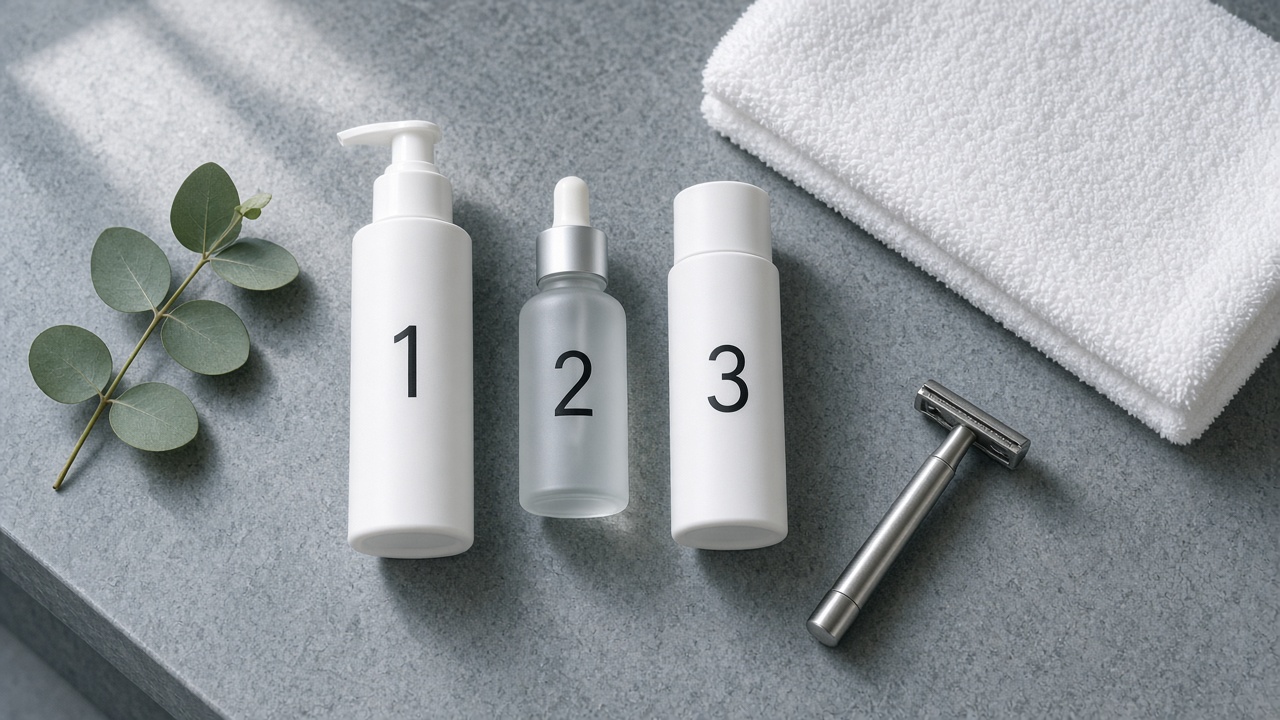
Scroll through any social feed this month and you’ll find two very different conversations about men and skin care.
On one side, there’s the joke that men “used to go to war, now they have a skincare routine”, plus endless arguments over whether real men moisturize. On the other, there’s a flood of 10-step routines, serums, eye creams and “must-have” gadgets that make the whole thing look like a part-time job.
The truth sits somewhere quieter in the middle. Dermatologists keep saying the same thing: most men need far fewer steps than social media suggests. Cleanse, moisturize, protect from the sun, and, if you want to level up, add one proven active ingredient at night. That’s it.
With the air getting colder and drier, autumn is the perfect time to set up that simple routine. Here’s how it works, what the experts say, what men on Reddit and X are actually doing, and how to deal with the shaving problems that wreck so many good routines.
The Big Shift: “Skinimalism” for Men
The trend has a name in beauty circles, “skinimalism”, but men have been doing a basic version of it for years. One men’s skin care brand summed it up on X: men have always had a routine of soap, shaving, deodorant and a bit of moisturizer when the skin needs it, so caring for your skin doesn’t need to mean 15 steps in front of the mirror.
Original article: X post on simple men’s skin care
The serious version of this idea comes from dermatologists. Professor Caitriona Ryan of Ireland’s Institute of Dermatologists puts it bluntly: most people need far fewer steps than social media suggests, and much of what’s sold is “optional” and not scientifically necessary. Her routine looks like this:
- Morning: cleanse, moisturize (if needed), SPF.
- Evening: cleanse, retinoid, moisturize (if needed).
She adds that a gentle cleanser “does not need to be expensive”, that moisturizer is only needed if your skin actually needs it, and that SPF should be worn every single day of the year.
Original article: Institute of Dermatologists – How many skincare steps do you actually need?
GQ’s 2026 guide to skin care for men lands in almost the same place. Its four “essential to-dos” are cleanse, hydrate, rejuvenate and protect. In practice, that means a good cleanser, a well-made moisturizer, daily SPF, an occasional exfoliator, and, as a bonus, a retinol, which GQ calls a “new baseline” essential.
Original article: GQ – Skin Care for Men in 2026: Your New Simple & Affordable Routine
Step 1: Cleanse (Gently)
Cleansing removes oil, sweat, pollution and sunscreen. The mistake many men make is using whatever bar soap is in the shower, which can leave skin tight and dry, especially in autumn and winter.
The American Academy of Dermatology (AAD) suggests choosing products based on your skin type:
- Acne-prone or oily skin: look for cleansers and moisturizers labelled “oil free” or “non-comedogenic”, meaning they won’t clog pores.
- Sensitive skin: choose mild, fragrance-free products. The AAD warns that “unscented” products can still contain masking fragrances that irritate.
Original article: AAD – Skin care tips for men
Practical tips
- Lukewarm water, not hot. Hot showers feel great in October but dry out the skin.
- Thirty to sixty seconds is enough. Massage, rinse, pat dry.
- Once or twice a day. Night is the important one, because it removes the day’s sunscreen and grime.
- Bearded? Wash the skin under the beard too, not just the hair.
Step 2: Moisturize (While the Skin Is Still Damp)
The AAD explains that moisturizer works by trapping water in the skin, which can help reduce the look of fine lines and make skin look brighter. Its tip: apply moisturizer right after bathing, showering or shaving, while the skin is still damp.
Autumn is when this step really pays off. Heated rooms and cold wind pull moisture out of the skin, and dry skin is more likely to sting, flake and react to shaving.
Original article: AAD – Skin care tips for men
Choosing a moisturizer
- Oily skin: a light lotion or gel, non-comedogenic.
- Dry skin: a richer cream, ideally with ingredients that support the skin barrier, like ceramides.
- Sensitive skin: fragrance-free, simple formulas.
- Want fewer steps? A daytime moisturizer with SPF 30 or higher covers steps 2 and 3 in one go.
Step 3: Sunscreen, Every Morning, Even in October
This is the step men are most likely to skip in autumn. It’s also the one dermatologists care most about.
The AAD recommends a broad-spectrum, water-resistant sunscreen with SPF 30 or higher on all exposed skin, including the scalp, ears, neck and lips. Reapply every two hours outdoors, or right after swimming or sweating. The reason: UV exposure leads to wrinkles, age spots and even skin cancer.
Original article: AAD – Skin care tips for men
Professor Nicola Ralph of the Institute of Dermatologists calls daily SPF “the single habit that protects everything else you do”. She points out that UV light reaches the skin all year round, including on cloudy days. She also suggests taking your SPF down over the neck and onto the backs of your hands, two areas men often forget.
Original article: Institute of Dermatologists – SPF and Retinol
The shortcut for men who hate “extra steps”
Professor Ryan’s tip for getting men into a sunscreen habit is a tinted mineral SPF that also works as a moisturizer. It removes a step entirely and can simply replace your post-shave moisturizer.
Original article: Institute of Dermatologists – How many skincare steps do you actually need?
The Optional Fourth Step: A Retinoid at Night
Once the basics are a habit, the one extra most dermatologists mention is a retinoid. That’s the family of vitamin A ingredients that includes over-the-counter retinol and adapalene, plus prescription options. Men’s Health has shared its feature on X several times this month: “Should Guys in Their 20s and 30s Be Using Retinol? Dermatologists Explain.”
Original article: Men’s Health on X
What the experts say
In that Men’s Health guide, dermatologist Dr. Shannon Humphrey says the late 20s or 30s can be a great time to start a consistent retinoid routine for healthy aging, while some men in their 20s may already use one for acne. The article’s advice for beginners:
- Start with a low strength, around 0.1 to 0.3 percent.
- Use roughly a pea-sized amount for the whole face, one or two nights a week at first.
- Apply to clean, completely dry skin, then follow with moisturizer.
- If your skin handles it after a few weeks, move to every other night, and eventually nightly if tolerated.
- Don’t skip sunscreen. Retinol makes skin more sensitive to sun damage.
Original article: Men’s Health – Retinol for Men: Benefits, How to Use It, and When to Start
Professor Ralph adds why retinol belongs at night: it can break down in sunlight and can make skin more sensitive to the sun. She also warns that mild dryness or flaking in the first few weeks is common and usually settles.
Original article: Institute of Dermatologists – SPF and Retinol
GQ gives the same warning in simpler words: ease in, because rushing retinol can cause peeling, redness and irritation. Start at twice a week at most.
Original article: GQ – Skin Care for Men in 2026
Note: This section summarizes publicly available information from dermatologists and reputable publications. It is not medical advice. If you have acne, a skin condition or very sensitive skin, or you take other medications, talk to a doctor, pharmacist or board-certified dermatologist before starting a retinoid.
Shaving: Where Good Routines Go to Die
Plenty of men set up a perfect routine and then ruin it with a rushed shave. Razor bumps came up a lot on X this month. A doctor’s post explaining that the bumps are “not pimples” passed 100,000 views. It’s especially common in men with curly facial hair, including many Black men, and a follow-up from another doctor explained the medical name, pseudofolliculitis barbae: curled hair curves back and pierces the skin after shaving.
Original article: X post on razor bumps
Original article: X post explaining pseudofolliculitis barbae
The AAD’s six razor-bump tips
- Grow it out if you can. Shaving causes razor bumps, so not shaving removes the cause.
- Learn your grain. Shaving against the direction of hair growth causes irritation. Pull the skin tight and look in the mirror to see which way your hair grows.
- Shave when hair is soft. At the end of a shower, or after holding a warm, damp washcloth on the area.
- Use the right products. A non-comedogenic cleanser first, a moisturizing shaving cream during, and a soothing aftershave after.
- Use good technique. Shave with the grain, rinse with warm water, then hold a cool, damp washcloth on the skin. Replace disposable razors after 5 to 7 shaves and store them dry. Clean electric razors every 5 to 7 shaves.
- Shave more often. Daily, or at least every 2 to 3 days, gives hair less time to grow and curve back.
The AAD warns that untreated razor bumps can leave grooves and raised scars, so if they continue after changing your habits, see a board-certified dermatologist.
Original article: AAD – 6 razor bump prevention tips from dermatologists
What wet shavers on Reddit recommend
On r/wicked_edge, Reddit’s big wet-shaving community, threads about irritation and ingrown hairs keep coming back to the same ideas: fewer blades and fewer passes, light pressure, a proper lather, shaving with or across the grain instead of against it, a cold rinse and a soothing balm after. If your skin is inflamed, shave less often or use a trimmer for a while. Some users say switching from multi-blade cartridges to a single-blade safety razor was what finally calmed their skin. Mileage varies, and bumps that last for months are a reason to see a dermatologist, not to buy another razor.
Original article: Reddit r/wicked_edge – How I eliminated ingrown hairs and irritation
Original article: Reddit r/wicked_edge – How do you avoid and get rid of razor bumps?
What Men on Reddit Wish They’d Known Earlier
A popular r/malegrooming thread asked men who started skin care in their 20s what they wish they’d known. The answers were refreshingly consistent:
- Sunscreen is the most important product, and it doesn’t need to be expensive.
- Consistency beats complexity. Keep it so simple and low-effort that you actually do it every day.
- Don’t fall down the rabbit hole. One commenter admitted buying a pile of unnecessary products after watching too many videos. Your skin doesn’t need six layers.
- Drugstore basics work. Gentle cleansers and moisturizers from brands like CeraVe and Cetaphil came up more than once as starting points.
- Add actives later. Vitamin C in the morning and a retinoid at night were the most common “next steps”, but only after the basics are a habit.
Original article: Reddit r/malegrooming – Men who started skincare in your 20s, what do you wish you knew earlier?
On r/SkincareAddiction, a man asked for the “best” anti-aging lineup, listing face wash, exfoliator, eye cream, day and night serums and more. The replies were short and to the point: morning is cleanser, moisturizer and sunscreen; evening is cleanser, retinol a few times a week and moisturizer. One commenter ranked the evidence simply: daily sunscreen first, retinoids second, and everything else a long way behind. They added that you should give a retinoid 8 to 12 weeks before judging it.
Original article: Reddit r/SkincareAddiction – Best men’s anti-aging face skin care routine
Your Autumn Routine on One Card
Morning (2 minutes)
- Gentle cleanser (or just water if your skin is dry).
- Moisturizer, or skip it if your sunscreen is moisturizing enough.
- SPF 30+ on face, ears, neck and the backs of your hands.
Evening (3 minutes)
- Gentle cleanser to remove sunscreen and grime.
- Retinoid, 1 to 2 nights a week to start (optional).
- Moisturizer.
Shave days
- Shave after the shower, with the grain, using a moisturizing cream.
- Cool washcloth, then moisturizer or a soothing aftershave.
- Skip the retinoid on any night your skin feels raw after shaving.
Give it time
- Basics: 4 to 8 weeks before deciding whether something works.
- Retinoids: 8 to 12 weeks, according to the Reddit and dermatology advice above.
Product Picks
Prices below were shown on the official brand pages at the time of writing and may change.
1. CeraVe Hydrating Facial Cleanser
A gentle, non-foaming cleanser that comes up constantly in beginner threads on Reddit. It’s a good autumn choice for normal to dry skin. Very oily skin may prefer a gel cleanser.
Price: $15.99 shown on the brand page (varies by size) – CeraVe Hydrating Facial Cleanser
2. CeraVe AM Facial Moisturizing Lotion with Sunscreen SPF 30
A moisturizer and SPF 30 in one bottle, so steps 2 and 3 become one. Some users find SPF lotions leave a slight sheen, so test how it sits under your beard or on oily skin.
Price: $19.99 (3 fl oz) – CeraVe AM Facial Moisturizing Lotion SPF 30
3. EltaMD UV Clear Broad-Spectrum SPF 46
A facial sunscreen marketed for acne-prone skin. Professor Ryan names the tinted version as an easy way to get men into a daily SPF habit. It’s pricier than drugstore options.
Price: from $46 – EltaMD UV Clear SPF 46
4. The Ordinary Retinol 0.2% in Squalane
A low-strength, low-cost retinol that matches the “start low” advice from Men’s Health. Squalane makes it a little gentler than water-based formulas. Still, begin at one or two nights a week and always pair it with SPF the next morning.
Price: $8.10 – The Ordinary Retinol 0.2% in Squalane
5. Differin Adapalene Gel 0.1%
An over-the-counter retinoid (adapalene) made for acne. It’s a common recommendation in Reddit threads for men who want one product for breakouts and texture. The brand says to use it once a day, morning or night but not both, and to give it 12 weeks. It can be irritating at first, so ease in. The price isn’t shown on the brand page and varies by retailer.
The Bottom Line
You don’t need a bathroom cabinet full of serums to have good skin. A gentle cleanser, a moisturizer that suits your skin, and sunscreen every single morning will do most of the work. Add a retinoid slowly at night if you want more, and treat shaving as part of skin care rather than a battle. Three steps, done every day, beat fifteen steps done for a week and then abandoned.