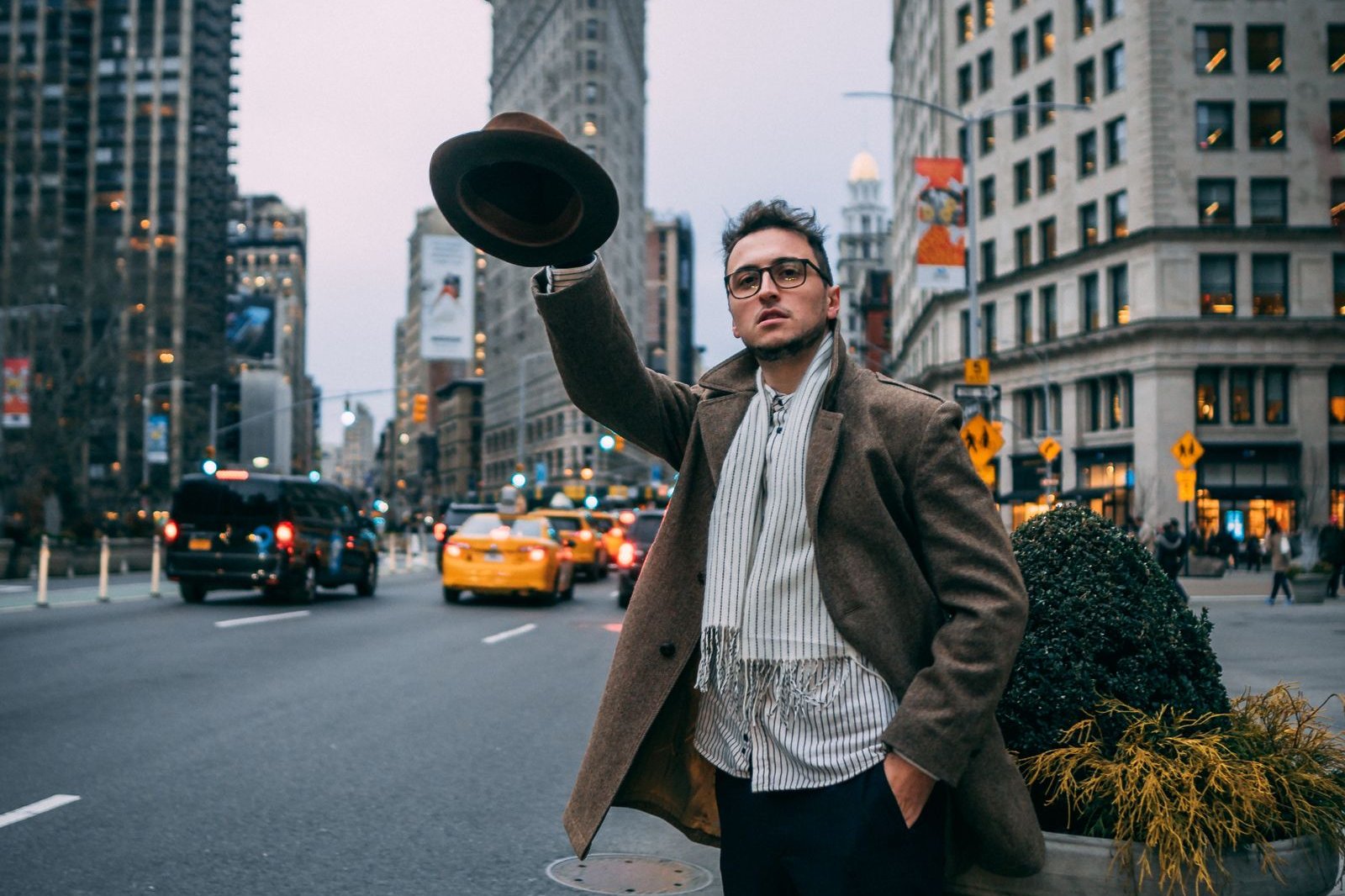
Autumn is hat season again. A good felt fedora or trilby keeps off the drizzle, frames a well-groomed beard and finishes an overcoat like nothing else. But a proper hat comes with a small responsibility many men have forgotten: knowing when to take it off.
You push open the heavy door of a Viennese coffeehouse and the waiter in his black waistcoat looks up. Hat on or hat off? And what about the hotel lobby, the lift, the bar or a mosque in Istanbul? This guide draws on the Emily Post Institute, Debrett’s, Gentleman’s Gazette, The Art of Manliness, GQ and hatmakers such as Lock & Co., Stetson and Optimo. It covers when to remove your hat, where to put it, how to hold and tip it, how customs differ in Britain, the US, Austria and Turkey, and how to choose a quality hat for autumn and winter.
Key takeaways
- The core rule: a gentleman’s hat comes off once he has arrived indoors: in homes, restaurants, coffeehouses, offices, theaters and most houses of worship.
- “Street-like” spaces are exceptions. Lobbies, public corridors, elevators in public buildings and public transport traditionally count as outdoors, so the hat may stay on.
- A useful modern rule (Gentleman’s Gazette): wear your hat in public spaces and take it off in private ones, meaning places where people live, work or pay to be.
- Caps and beanies follow the same rules as fedoras for men. Women’s fashion hats have more freedom, but should come off when they block someone’s view.
- Never put your hat on the dining table. Use the cloakroom, a hook, an empty chair or, as a last resort, your lap. To rest it on a shelf, hatmakers advise crown-down to protect the brim.
- Hold it by the brim, showing the outside, not the lining. Tip it for brief courtesies; remove it for the national anthem and when you stop to talk.
- Religious and medical head coverings are exempt. In houses of worship, follow local rules or ask.
Why Men Remove Their Hats at All
The Emily Post Institute explains that hat etiquette is about letting your face be seen, allowing eye contact and showing respect. Debrett’s still states plainly that “hats are not worn indoors”. Gentleman’s Gazette notes that uncovering the head is a sign of deference going back millennia, and traces hat tipping to bowing: a man removed his hat to bend from the waist, and as bows shrank, the hat gesture remained.
Original article: Etiquette Today: Classic Business Attire Questions – Emily Post Institute
Original article: Do Dress Codes Matter? – Debrett’s
Original article: Men’s Hat Etiquette Guide – Gentleman’s Gazette
The Golden Rule: Public Versus Private Spaces
Gentleman’s Gazette suggests a more precise principle than “outdoors on, indoors off”: wear your hat in public, take it off in private. A private space is any place where people live, work or pay a fee to enter. Everything else is generally public.
So a hotel lobby is public but the guests’ lounge is private; a theater lobby is public but the auditorium is private; and in a restaurant the bar is public, but once you are seated at your table you are in a private space.
Where to Take Your Hat Off and Where It May Stay On
| Place | Hat on or off? | Notes |
|---|---|---|
| Coffeehouse, café | Off once you sit down | Emily Post lists restaurants and coffee shops as hat-off places |
| Restaurant dining room | Off at the table | Never wear a hat while eating with others |
| Bar | Traditionally may stay on | Gentleman’s Gazette counts the bar as a public space; off if you sit down to dine |
| Hotel lobby, reception | May stay on | Public space; off in the guest lounge, your room or the restaurant |
| Someone’s home | Off on entering | The entrance hall is the traditional exception, where your host takes your hat |
| Office | Off indoors at work | Lobbies and public corridors may count as outdoors |
| Elevator | Depends | Emily Post: may stay on; older rules: off in residential or hotel lifts, especially if a lady enters |
| Public transport, airports, post office | May stay on | Emily Post lists these as hat-on places |
| Theater, cinema, concert | Off in the auditorium | Lobby counts as public |
| Church | Off for men | Unless local custom differs |
| Synagogue, gurdwara and others | Follow the rules; heads are often covered | Ask if unsure |
| Mosque | Follow posted rules | Shoes off; women cover their heads; modest dress |
Coffeehouses and Restaurants
The Emily Post Institute is clear: men remove hats, including baseball caps, “in restaurants and coffee shops” and “at mealtimes, at the table”. In a large building, lobbies and elevators often count as outdoor spaces, while hallways, dining areas, rooms and offices count as indoors.
Original article: Hats Off! Hat Etiquette for Everyone – Emily Post Institute
Hotels, Offices and Elevators
Here the rules have softened. The Art of Manliness quotes a classic etiquette guide: keep your hat on only in places “akin to public streets”, such as lobbies, corridors and crowded elevators in non-residential public buildings. It notes that “Apartment house elevators and halls are classed as indoors, and so are eating places!”
Original article: How to Be a Gentleman From Head to Toe: The Anatomy of Etiquette – The Art of Manliness
American hatmaker Levine Hat Co. follows the traditional view. In public buildings the elevator is a public area, but a gentleman removes his hat when a lady enters an elevator in a building “which can be classified as a dwelling”, such as a smaller hotel or apartment house. GQ’s style columnist argued that in today’s crowded lifts it is often more prudent to leave the hat on your head, “where it doesn’t compete for floor space”.
Original article: Hat Etiquette – Levine Hat Co.
Original article: Hat Etiquette – GQ
Our advice: keep it on in an office-tower lift; lift it off in the small elevator of a boutique hotel or private residence.
Houses of Worship
Men traditionally remove their hats in Christian churches, while the classic guide quoted by The Art of Manliness makes an exception for the synagogue, where men cover their heads. Gentleman’s Gazette’s advice is wisest: if you do not know the rules, ask. For mosques in Turkey, Diyanet’s visitor rules ask you to remove your shoes, wear clothing covering shoulders, arms and knees, and, for women, to cover the head.
Original article: Rules to Follow During a Mosque Visit – Diyanet, Kuşadası Mufti’s Office
Emily Post notes that religious head coverings and caps worn for hair loss from medical treatment never have to be removed.
Where to Put Your Hat
In order of preference:
- The cloakroom or hat check, as Emily Post recommends at formal meals. In Vienna, the Garderobe is part of the ritual.
- A hat rack or coat stand near the entrance.
- An empty chair or the back of your chair. GQ suggests asking the host where to store it.
- Your lap, if there is truly no other option. Emily Post says choose it over the floor: “this isn’t your fault.”
Never on the dining table. The table is for food and glasses, not headwear.
When you do rest a hat on a shelf, bench or side table, hatmakers agree on technique. Optimo advises placing a hat “either upside down on the crown, or flat on its brim with the brim snapped up”. Stetson recommends storing a felt hat upside down on its crown on a clean surface “to keep the brim from flattening out”. Crown-down is correct hat care; etiquette simply keeps it off the table where people eat.
Original article: Service Guide – Optimo Hats
Original article: Frequently Asked Questions – Stetson
How to Hold, Tip and Doff Your Hat
Holding Your Hat
Levine Hat Co. notes that a removed hat is held so that only the outside, never the lining, is visible. Handle it by the brim: Optimo warns that pinching the crown can weaken felt and “severely damage straw hats”, and Stetson advises handling the crown as little as possible.
Tipping Your Hat
The hat tip accompanies brief courtesies: hello, goodbye, thank you, excuse me. The classic etiquette quoted by The Art of Manliness says to lift the hat slightly off and forward, by the front crown of a soft hat or the brim of a stiff one, while nodding. Given the hatmakers’ advice, a light touch at the brim protects your felt.
| Gesture | When | How |
|---|---|---|
| Touch the brim | Greeting a friend or acquaintance in passing | Fingertips to the brim, a slight nod |
| Tip (lift) the hat | Brief courtesies: thanks, hello, excuse me | Lift slightly off the head and forward, then replace |
| Remove the hat | Stopping to talk to a woman, being introduced, entering a home | Take it off and hold it at your side, lining inward |
The Art of Manliness’ guide adds that a gentleman removes his hat “whenever you pray or witness a religious ceremony, as at a burial, outdoor wedding, dedication”.
Anthem and Flag
In the United States, the rule is written into federal law. During the national anthem, “men not in uniform, if applicable, should remove their headdress with their right hand and hold it at the left shoulder, the hand being over the heart”. Emily Post adds that hats are removed when the US flag passes by, as in a parade.
Original article: 36 U.S. Code § 301 – National anthem – Legal Information Institute, Cornell Law School
Caps, Beanies, Fedoras and Flat Caps: Same Rules?
For men, yes. Emily Post’s hat-off list explicitly includes baseball caps, and a beanie or tweed flat cap is still a hat. The practical difference: felt hats need careful handling and a place to rest, while flat caps and beanies fold into a coat pocket. At athletic events, indoors or out, Emily Post allows hats on.
Women’s Hat Etiquette, Briefly
Traditional rules treat women’s hats as part of the outfit. Emily Post says women’s fashion hats may stay on in someone’s home, at luncheons, weddings and religious services. They should come off whenever they block someone’s view, and indoors at work. Lock & Co. notes that a woman would remove a large-brimmed hat in church and at a sit-down wedding dinner. Unisex caps follow the men’s rules.
Original article: Wedding Hat Etiquette – Lock & Co. Hatters
Traditional Rules Versus Modern Practice
Michigan State University Extension notes that men are no longer expected to tip their hats in passing to women, but are still expected to remove them for the national anthem. Some rules have softened, such as hats in busy lifts and greeting women in the street. Others have not: the restaurant table, someone’s home and the office remain hat-off.
Original article: When should men remove their hats? – Michigan State University Extension
Cultural Differences
United Kingdom
British etiquette remains the most formal. Debrett’s states that hats are not worn indoors. At Royal Ascot’s Royal Enclosure, a top hat is required, though Lock & Co. notes that it “may be removed indoors or in private spaces, such as a hospitality box”. At weddings, top hats should be removed in church and inside the reception venue, “even for photographs”.
Lock & Co., founded in 1676, is still at No. 6 St James’s Street in London.
Original article: Top Hats for Royal Ascot and Formal Events – Lock & Co. Hatters
Original article: Our History – Lock & Co. Hatters
Austria and the Viennese Kaffeehaus
Viennese coffeehouse culture entered Austria’s UNESCO intangible heritage inventory in 2011. The Austrian UNESCO Commission describes marble-topped tables, Thonet chairs and newspaper tables in a place “in which time and space are consumed, but only the coffee is listed on the bill”. Café Kramer on the Graben first offered newspapers in 1720, and coffeehouses, once for men only, admitted women in 1856.
Original article: Viennese coffee house culture – Austrian Commission for UNESCO
Vienna’s tourist board adds that the glass of water served with coffee was originally a place to rest your spoon.
Original article: 10 amusing facts about the Viennese coffee house – vienna.info
Kaffeehaus hat etiquette: remove your hat as you step in and hang it with your coat on the rack or at the Garderobe; catch the waiter’s eye rather than calling out; linger over one coffee and a newspaper; and put your hat back on outside, not at the table.
Vienna also has its own hat dynasty. Mühlbauer was founded in 1903 by milliner Julianna Mühlbauer in the Viennese suburb of Floridsdorf, and is now run by the fourth generation, Klaus Mühlbauer.
Original article: History – Mühlbauer
Turkey: From the Fez to the Hat Law
Turkey’s hat history is unusually political. According to the TDV Encyclopedia of Islam, the fez was introduced by Sultan Mahmud II for the new army after the Janissaries were abolished in 1826. A decree of 1829 replaced the earlier headgear with a dark red fez, which then spread to civilians. In 1925, the young Republic passed Law No. 671 on the wearing of hats. It required members of parliament and public officials to wear the hat and declared the hat the general headwear of the people of Turkey. The fez disappeared from everyday life.
Original article: Fes – TDV İslâm Ansiklopedisi
Original article: Şapka İktisası Hakkında Kanun (Law No. 671) – Mevzuat.gov.tr
Today, Western hat etiquette generally applies in Turkish homes, restaurants and offices, alongside respect for religious headwear.
Choosing a Quality Hat for Autumn and Winter
| Hat | Best with | Formality |
|---|---|---|
| Fur felt fedora | Overcoats, suits, tweed jackets | Smart, versatile |
| Trilby (shorter brim) | Smart casual, travel | Smart casual |
| Homburg | Dark overcoat, evening | Formal |
| Flat cap | Tweed, knitwear, waxed jackets | Casual to smart casual |
What to look for:
- Fur felt over wool felt. Rabbit or beaver fur felt is denser and smoother; wool felt is an affordable start.
- Fit. Have your head measured. Optimo notes that its standard sizes are cut more oval than round, and offers custom molds for unusual head shapes.
- Proportion and colour. A medium brim suits most men; charcoal, brown and navy work with most coats, black is more formal.
- Care. Brush it, keep it away from heat and store it crown-down or in its box.
Original article: Custom – Optimo Hats
Premium Picks for Autumn and Winter
Prices were checked on each maker’s official online store at the time of writing. British and European makers list prices in pounds or euros.
| Hat | Material | Price at the time of writing |
|---|---|---|
| Borsalino Federico Lined Alessandria Shaved Felt | Felt, lined | $585 |
| Mühlbauer Gentleman’s Hat UDO H | Antelope felt | €425 |
| Lock & Co. Voyager Rollable Trilby | Soft felt, packable | £425 |
| Lock & Co. Haydock Fedora | Rabbit fur felt | £395 |
| Stetson Temple Fedora | Royal Deluxe fur felt | $290 |
| Christys’ Bond Fur Felt Trilby | Fur felt, handmade in Britain | £240 |
Borsalino Federico Lined Alessandria Shaved Felt
The Italian icon’s fully lined felt fedora.
Price: $585 – Borsalino Federico Lined Alessandria Shaved Felt
Mühlbauer Gentleman’s Hat UDO H
Viennese antelope felt, made for a Kaffeehaus afternoon.
Price: €425 – Mühlbauer Gentleman’s Hat UDO H
Lock & Co. Voyager Rollable Trilby
Super-soft felt with an unblocked crown that rolls up for travel.
Price: £425 – Lock & Co. Voyager Rollable Trilby
Lock & Co. Haydock Fedora
A classic country fedora in rabbit fur felt with a grosgrain ribbon.
Price: £395 – Lock & Co. Haydock Fedora
Stetson Temple Fedora
Royal Deluxe fur felt, a center-pinch crown, snap brim and satin liner.
Price: $290 – Stetson Temple Fedora
Christys’ Bond Fur Felt Trilby
Handmade in Britain with a wide Italian ribbon and Christys’ red crest lining.
Price: £240 – Christys’ Bond Fur Felt Trilby
FAQ
Should I take my hat off in a coffee shop?
Yes. Emily Post lists restaurants and coffee shops among the places where men remove their hats, including baseball caps.
Can I wear my hat in a hotel lobby or elevator?
Yes, lobbies and public-building elevators are treated like the street. In a small hotel or residential lift, removing it is more gracious.
Where should I put my hat in a restaurant?
Cloakroom first, then a hook, an empty chair or the back of your chair, and your lap as a last resort. Never the dining table.
Is it rude to wear a baseball cap indoors?
For men, the same rules apply as for a fedora; Emily Post explicitly includes baseball caps.
Do I have to remove my hat in a mosque?
Follow the posted rules: Diyanet asks visitors to remove shoes, dress modestly and, for women, cover their heads. Religious head coverings are always respected.
The Bottom Line
Hat etiquette comes down to one idea: show your face and show respect. Keep your hat on in street-like spaces such as lobbies, corridors and trains; take it off where people live, work, dine, worship or have paid to be. Give it to the cloakroom, never the dining table, hold it by the brim, and tip it with a smile. From a London club to a Viennese Kaffeehaus, these small gestures quietly mark a gentleman.