
For a long time, the American gentleman’s jewelry box was a quiet place: a wedding band, a watch, maybe a pair of cufflinks for black-tie nights. That era is over. Men’s jewelry in 2026 is no longer a niche flex or a red-carpet stunt. It is how stylish men finish a white T-shirt and jeans, how they mark a life moment without a tattoo, and how they make a navy suit look considered rather than generic. This guide covers the pieces that matter for gentlemen—signet rings, gold chains, bracelets, cufflinks, tie bars, lapel pins and discreet studs—plus the etiquette of matching metals, wearing a watch with bracelets, and knowing when enough is enough.
Key takeaways
- Start with one strong piece. A medium-weight chain, a lived-in signet, or a slim metal cuff is enough to change how an outfit reads.
- Match metals with intention. Stainless steel, silver, white gold and platinum form one family; yellow gold, rose gold, brass and copper form another. Mixed metals work in 2026 when the contrast looks deliberate.
- The classic signet sits on the pinky of the non-dominant hand; modern wearers also use the ring or index finger. Keep the wedding band where it belongs.
- Bracelets and watches need space. Prefer a solo metal bracelet on the free wrist, or one slim bracelet next to a watch—not a noisy stack that fights the timepiece.
- Business jewelry stays functional: watch, wedding band, cufflinks, tie bar, quiet lapel pin. Save statement chains and stacked beads for after hours.
- Care is part of luxury. Soft cloths, mild soap, separate pouches, and professional polish once or twice a year keep gold and silver looking intentional.
1. The 2026 Men’s Jewelry Boom: New Stones, New Rules
Esquire’s October 2026 report from the Wynn Las Vegas trade shows captures the scale of the shift. The global men’s jewelry market was valued at about $48.56 billion in 2024 and is projected to reach roughly $124 billion by 2034, with North America accounting for a large share. More important than the numbers is the culture change. Dealers told Esquire that fathers and grandfathers were locked into watches, cufflinks and a wedding band. Today’s collectors move from clothing to watches to jewelry with the same connoisseur’s patience they once reserved for Patek references.
Colored gemstones are part of that story. As lab-grown diamonds flooded the market and diamond mystique weakened, dealers reported more interest in emeralds, rubies, sapphires and hard stones such as lapis, carnelian and malachite. Brooches that would once have read as strictly feminine—Tiffany Bird on a Rock pieces, Bulgari high jewelry, Cartier Juste un Clou pins—are appearing on men’s lapels. Tiffany’s Bill Rhodes put the new rule simply: men’s jewelry should be dictated by the wearer’s style and confidence, not by a closed list of “acceptable” stones.
For a gentleman, the practical reading is not that you must pin a $200,000 brooch to your suit. It is that the old fear of looking “too much” for wearing a good chain, a signet or a refined bracelet is outdated. Substance, provenance and personal meaning now outrank the old diamond-only playbook.
Why it matters: Men’s jewelry is no longer a guilty afterthought. Treat it like your watch collection—buy fewer pieces, buy better ones, and wear them with conviction.
Original article: The Explosion in Men’s Jewelry Is Breaking All the Old Rules – Esquire
2. Chains First: The Backbone of Modern Men’s Jewelry
If you are new to men’s jewelry, GQ’s 2026 edit is blunt: start with a chain. A necklace is a “set and forget” accessory you can wear out when you want shine and tuck under a shirt when you do not. Silver reads quieter and cooler; gold carries historic weight and warmth. Cuban links, Figaro strands, oval links and rope chains dominate both necks and wrists this year.
Gabriel & Co.’s men’s jewelry trends briefing for 2026 confirms the same hierarchy. Chains are the backbone of the look—thick or lean, gold or silver, layered or solo. What is changing is the willingness to mix sizes, tones and finishes: a two-tone Cuban next to a polished Figaro bracelet, or a single heavy gold link against an open collar. Styling advice from the same guide is practical for gentlemen: start with one chain that sets the tone, then complete the rhythm with a coordinating bracelet rather than chasing perfect symmetry.
GQ’s shopping list shows the quality range available now, from understated Miami-made Miansai pieces designed for men who “don’t wear jewelry” to solid-gold Mejuri chains and more sculptural British and European makers. The gentleman’s move is not the thickest Cuban in the case. It is the chain whose weight feels right against a knit polo or a spread-collar shirt, and whose metal agrees with your watch.
Why it matters: A gold chain for men is the single most versatile entry into men’s jewelry. Get the length and gauge right once, and you will wear it for a decade.
Original article: 26 Best Men’s Jewelry to Buy in 2026 – GQ
Original article: Men’s Jewelry Trends 2026 – Gabriel & Co.
3. The Signet Ring Returns: Pinky Etiquette and Power Rings
The signet ring is the heirloom of the men’s jewelry revival. John Hardy reminds readers that signets once sealed wax on documents; in British and European tradition the pinky of the non-dominant hand was the classic placement, with the left little finger signaling taste and heritage. Modern wearers also put signets on the ring finger, middle finger or index. The ring finger tends to read elegant and formal; the middle finger commands more attention. If the left hand already carries a wedding band, the right pinky remains a clean, classic solution.
Gabriel & Co. describes 2026 signets as less crest-bound and more expressive: oversized faces, textured metal, geometric lines, enamel or unexpected stones. The brand’s styling tip matches gentlemanly restraint—one bold ring on each hand rather than a crowded stack, and a ring that looks lived-in rather than pristine. Esquire India and Forbes-facing industry voices make the same point in different words: the signet is personal storytelling, not costume.
Finger meanings still matter socially. The Art of Manliness notes that wedding bands are always acceptable; class and fraternal rings are usually fine in American professional life; championship rings are best saved for the right room. Decorative rings require more judgment. For most gentlemen, one or two rings total—wedding band plus signet—is the confident, non-theatrical default.
Why it matters: A signet ring is the men’s ring that carries history without shouting. Place it with intention, match its metal to your watch, and let it be the hand’s focal point.
Original article: How to Wear a Signet Ring – John Hardy
Original article: A Man’s Guide to Wearing Jewelry – The Art of Manliness
4. Bracelets, Cuffs and the Watch Question
Bracelets are where men’s jewelry either looks composed or looks like a souvenir drawer. MR PORTER’s classic “man-bling” guide remains one of the clearest etiquette maps: a metal bracelet works best as a standalone piece on the free wrist rather than clanking against a watch; leathers should agree in tone with watch straps; beaded stacks should top out around three or four strands; and the metals of your accessories should “agree”—steel, silver, white gold and platinum on one team, brass, copper, yellow gold and rose gold on the other.
Gabriel & Co. updates that map for 2026 with elevated beaded bracelets in matte stones, hematite, tiger’s eye and lava rock paired with metal spacers, plus black accents in enamel, onyx, spinel or titanium. Mixed metals are no longer a faux pas when the contrast looks collected over time rather than accidental. GQ’s bracelet picks for 2026 run from approachable gold chains to John Hardy’s Heishi beaded bracelet at $825 and Cartier’s iconic Love bracelet for men who want a locked-on classic.
Jeff Goldblum’s stylist, speaking to Time+Tide, pushed the same minimalism many watch collectors already feel: piles of beads next to a serious Rolex often look restless. A pinky ring with a watch can look excellent; a crowded bracelet stack next to a complicated dial usually does not. The gentleman’s formula is simple. Either the watch is the wrist statement and jewelry stays to one slim companion, or the bracelet is the statement and the watch moves to the other wrist—or stays in the drawer for the evening.
Why it matters: Watches and bracelets share real estate. Decide which one leads, then dress the rest of the wrist in supporting roles.
Original article: How To Carry Off “Man-bling” – MR PORTER
5. Cufflinks, Tie Bars, Lapel Pins and Matching Metals
Tailoring still has its own jewelry grammar. Oswin Hyde’s September 2026 accessory guide reduces it to three rules: match leathers, match metals, and let one accessory stand out. Belt, shoes, watch strap and wallet live in the same color family. Buckle, watch, cufflinks and tie bar share one metal family. Then choose a single point of interest—a patterned tie, a bright pocket square or a slightly bolder cufflink—and keep everything else quiet.
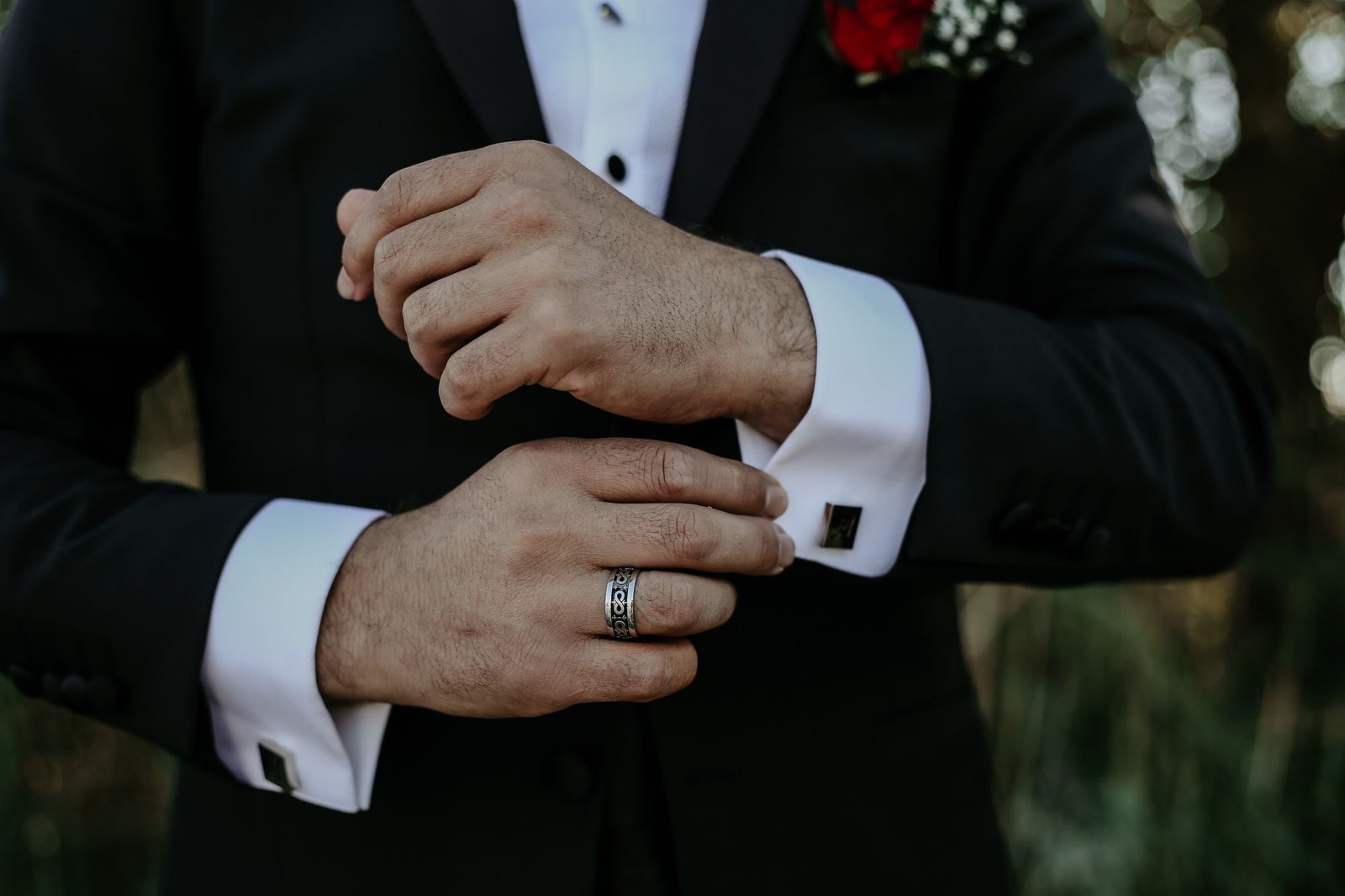
The Art of Manliness still frames cufflinks and shirt studs as functional jewelry: double or French cuffs for cufflinks, studs mainly for black tie, simple precious-metal designs for formality, novelty designs for parties. Tie bars should be narrower than the tie and sit roughly between the third and fourth buttons. Lapel pins work when they are small, meaningful and not competing with a loud pocket square. Earrings and studs have wider acceptance in 2026 cities—GQ treats pierced ears as a settled part of men’s jewelry—but conservative offices still prefer them off or minimal.
Matching metals to the belt buckle remains one of the fastest ways to look intentional. A steel Rolex with a silver buckle and platinum-toned cufflinks reads as one system. A yellow-gold Cartier with a gold buckle and gold signet reads as another. Two-tone watches can bridge both, but only if the rest of the metal story is edited.
Why it matters: Formal men’s jewelry is not decoration first. It is hardware that keeps a shirt and tie behaving—and metals that quietly agree.
Original article: How to Match Men’s Accessories – Oswin Hyde
6. How Much Is Too Much? Building a Gentleman’s Jewelry Rotation
“How much is too much” is the question every man asks once the first chain feels good. Etiquetteer, citing older Esquire and Amy Vanderbilt guidance, still argues that simplicity and severity are the traditional hallmarks of a gentleman’s jewelry, with the pinky as the proper signet finger and a general preference for less rather than more. The Art of Manliness adds dress-code realism: in corporate America, “tasteful” often still means watch, wedding band, cufflinks, tie accents and lapel pins during the workday. Bracelets, decorative rings and earrings may be acceptable after hours or in creative industries, but the burden of appropriateness stays on the wearer.
A practical rotation for a premium wardrobe looks like this:
- Daily: watch + wedding band; optional thin chain under the shirt; optional single slim bracelet on the free wrist.
- Business formal: steel or gold watch, matching cufflinks and tie bar, wedding band, optional discreet lapel pin. No noisy bead stacks.
- Smart weekend: medium Cuban or Figaro chain, one signet, leather or beaded bracelet if the watch is casual.
- Black tie: shirt studs and cufflinks in one metal; slim dress watch on black leather or no watch; leave the day chain at home.
MR PORTER’s closing Chanel-adjacent advice still holds: before you leave the house, look in the mirror and take one thing off. If two pieces are fighting for attention, remove the louder one.
Why it matters: Luxury men’s jewelry should look inevitable, not accumulated. Edit until the outfit breathes.
Original article: A Gentleman’s Rings – Etiquetteer
7. Care, Storage and Keeping Precious Metal Looking Intentional
Buying well is only half of men’s jewelry etiquette; keeping pieces presentable is the other half. GQ’s jewelry FAQ is a useful home-care primer. Sterling silver 925 means 92.5 percent silver; the rest is usually copper for strength. Silver will oxidize and take on a darker patina, which many men like, but lemon-and-vinegar solutions, an aluminum-foil and baking-soda bath, or a dedicated silver cloth restore shine when you want it bright again. Gold jewelry cleans best in warm water with a drop of mild detergent or baby shampoo, then a soft dry cloth—avoid chlorine and harsh soaps. Gold plating wears at high-friction points such as the back of the neck; remove plated pieces before showering.
John Hardy advises soft cloths and mild soap for signets, professional polish once or twice a year, and storage in a soft pouch or jewelry box away from other metal pieces that can scratch engraved faces. Le Gramme’s care note on MR PORTER is equally clear: surface marks are normal with time, but store items separately and clean regularly. The gentleman’s kit is small: a microfiber cloth, a soft pouch for travel, silica packs in the drawer, and a relationship with a jeweler who can re-tip a worn clasp or resize a ring properly.
Why it matters: Neglected metal looks accidental. Cared-for metal looks like you meant it.
Original article: 26 Best Men’s Jewelry to Buy in 2026 – GQ
Beard-Knight Picks: Men’s Jewelry Worth Owning
- LE GRAMME 8g Punched Ribbon Recycled-Titanium Cuff at MR PORTER, $1,155: A Paris-made black recycled-titanium cuff engraved with the illusion of three stacked bracelets and the piece’s weight in grams—the brand’s signature. Ideal as a solo wrist statement opposite a steel watch.
- Cartier Juste un Clou ring, small model, $1,480 (yellow or rose gold): The nail-inspired classic for men who want a modern alternative to a traditional signet. White gold starts at $1,580.
- Tiffany Elsa Peretti® Bean® design cuff links in sterling silver, $850: A quiet, sculptural cufflink for French cuffs; yellow-gold Bean cufflinks are listed at $9,200 for men who want the same design in solid gold.
- Cartier LOVE bracelet, classic model: The 1969 screw-motif icon GQ still treats as a modern classic for men; choose yellow gold when your watch and buckle already live in that metal family.
- John Hardy Heishi Beaded Bracelet, $825 (as listed by GQ): An elevated beaded option when you want texture next to a watch without resorting to souvenir cords.
FAQ: Men’s Jewelry for Gentlemen
How should a man start wearing jewelry?
Begin with one piece you will actually wear every day: a medium chain, a slim metal cuff, or a signet. Add cufflinks and a tie bar when your shirts and ties need them. Build slowly so metals and weights stay coherent.
Which finger is correct for a signet ring?
Traditionally the pinky of the non-dominant hand. The ring or index finger is acceptable in modern styling. Keep the wedding band on its usual finger and avoid overcrowding one hand.
Can I wear a bracelet with my watch?
Yes, if you keep it minimal. Prefer one slim bracelet that shares the watch’s metal family, or wear a statement bracelet on the opposite wrist. Avoid thick multi-strand stacks next to a complicated dress watch.
Should men’s jewelry match the belt buckle?
For tailored outfits, yes. Match buckle, watch case or bracelet, cufflinks and tie bar to one metal family. Casual mixed-metal looks can break the rule when the contrast looks intentional.
How do I clean gold and silver jewelry?
Use warm water with mild detergent for gold, then dry with a soft cloth. For silver, a silver cloth or a gentle home polish restores shine; store pieces separately so they do not scratch each other.
Conclusion
Men’s jewelry for gentlemen in 2026 is about edited confidence: a signet that means something, a gold chain that sits right against the collarbone, cufflinks that agree with the watch, and the discipline to leave one piece in the drawer. Buy metals that match your life, not a trend board. Wear less than you own. And treat every clasp, engraving and polished face with the same care you already give good leather and a good suit.